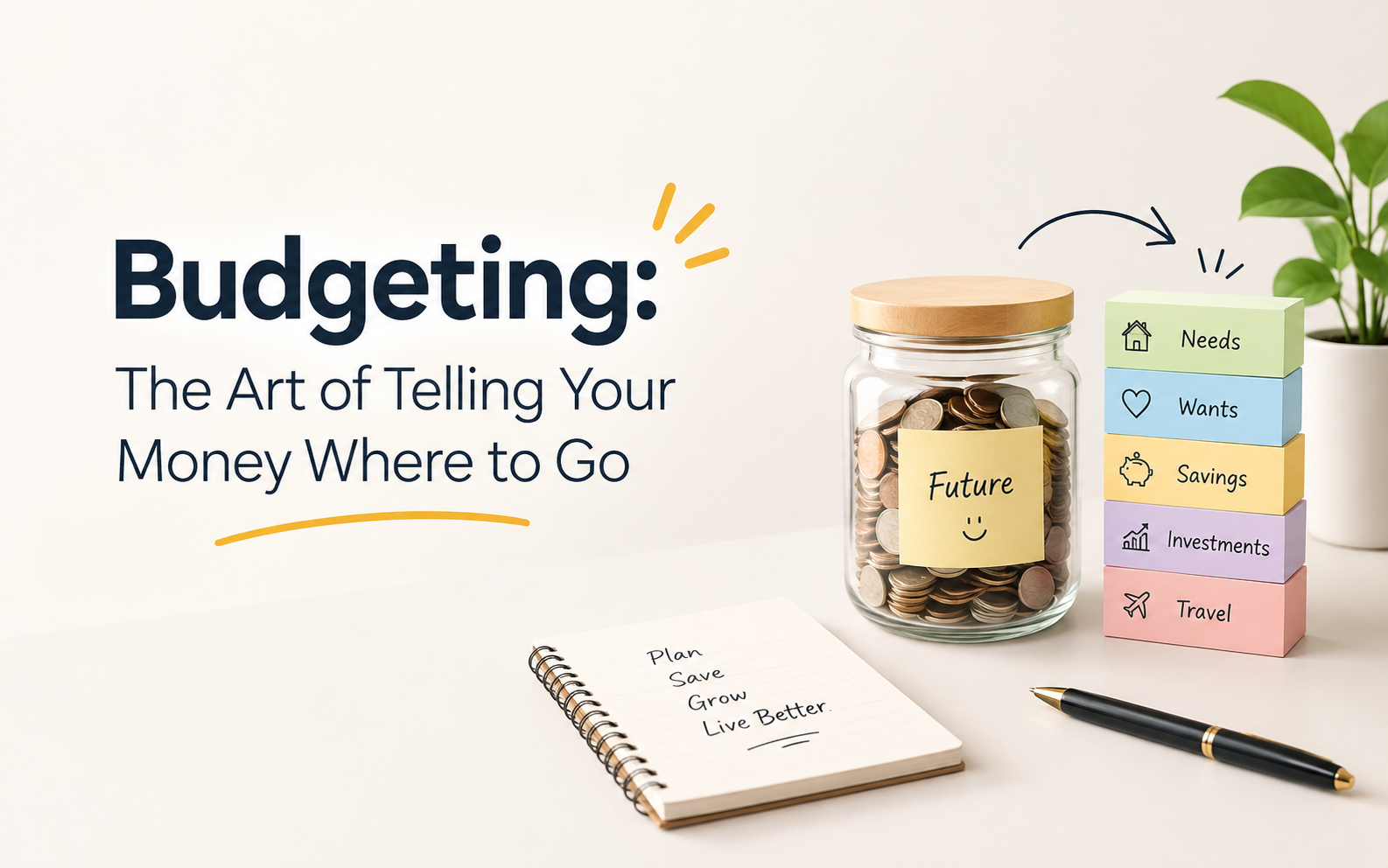
There is this beautiful quote that I stumbled upon and thought would be an incredible introduction to this post:
"A budget is telling your money where to go instead of wondering where it went." John C. Maxwell
I love this quote, because what most of us actually require is a direction. Our paychecks are not small, but they are also unsupervised. Give them a task, a job, and they're bound to deliver.
Let's discuss the unglamorous superpower of budgeting that will change your life forever.
Why Budgeting Feels Like a Diet (and Why It Shouldn't)
We tend to approach budgeting the same way we approach diets - with enthusiasm on Monday and a sense of betrayal the second Wednesday rolls around. Both diets and budgets are commonly associated with restrictions. Don't buy this, don't spend that, deny yourself this, that, and the other thing.
But what most of us fail to realize is that a good budget is the permission to spend guilt-free on the things that we actually care about, with everything else - the things we don't care about - taken care of.
"A budget doesn't limit your freedom; it gives you freedom." Rachel Cruze
The Truth About Your Emotions That No One Talks About
Before we get into the nitty-gritty details of building a functional budget, it might be helpful to discuss the psychology behind budgeting.
Most commonly, a budget fails not because of a flaw in the system but because of a flaw in us and the way we approach the process. We tend to spend more when we are stressed, bored, shopping, grieving, celebrating, feeling down, or just generally want to feel something different. Money for many of us is rarely just money, it is comfort, it is status, it is power, it's the easiest drug that we are willing to waste our precious resources on.
A budget without consideration of our psychology is a doomed one. It's a fact - the most successful budgets are the ones that incorporate our flaws instead of pretending they aren't there.
Here is a tip that I find incredibly underrated and something that many of us are really missing in our budgeting journey.
Build fun into the budget on purpose
Make it an item, something for you to look forward to, a guilty pleasure, entertainment, coffee funds, whatever makes you happy. A budget without room for spontaneity is like a diet without chocolate. It might last but eventually, you'll come unstuck.
The Building Blocks of a Budget That Actually Works
Now, without any further ado, here is my guide to building a budget that actually works. These are some of the most useful building blocks that will ensure your budget isn't just a theory but rather a fully functioning entity that helps you reach all of your financial goals.
- Know Your Numbers First
Track your spending for the next 30 days before you even think about creating a budget - you cannot budget what you don't understand
Categorize your needs and wants with brutal honesty, things like rent, groceries and insurance are needs while the fourth subscription and the food delivery app you opened out of boredom are wants
List out all of your income streams no matter how small to make sure nothing comes as a surprise later
Write down all of your subscriptions because most of us are in for a unpleasant surprise at the end of the month
- Choose a Budgeting Framework, Any Framework
There are countless budgeting systems out there but what most of us miss is the fact that the most important part is the one that we will actually stick to.
- 50/30/20 Rule - 50% needs, 30% wants, 20% savings and debt repayment
- Zero-Based Budget - every rupee has a job until your income minus expenses equals zero
- The Envelope System - physical representation of your money with categories that you cannot go over
- Pay-Yourself-First Budget - savings and investment come first
- Automate What You Can
Set up automatic transfers to your savings account on the day you get your paycheck before you do anything else so that you cannot say no
Automate your bill payments to avoid late fees that are one of the biggest silent drains of our income
By automating your budget you're taking human error out of the equation entirely, which is something that will benefit you immeasurably
"Do not save what is left after spending, but spend what is left after saving." Warren Buffett
This one piece of financial advice is so important that it deserves its own section. Simply put, the best way to budget is to budget backwards. When you save first, everything else falls into place.
- Create the Boring but Beautiful Emergency Fund
Aim to save between 3-6 months of your living expenses
Keep it boring and safe in a savings account rather than the stock market or your cousin's business idea
This fund is not for things like vacation or shopping, it's for the truly unforeseen circumstances, like a sudden job loss or a medical emergency
Until you have this, everything else you're doing is on shaky ground
- Track Debt With Eyes Wide Open
Make a list of all your debts along with their interest rates, not the amount owed, but the percentage that you will have to pay extra
Choose between the avalanche method (pay off highest interest rate first) for mathematical simplicity or the snowball method (pay off smallest balance first) for psychological benefit
Avoid taking on new debt while paying off old debt, which is easier said than done but is the number one reason why people fail at budgeting
- Review Your Budget Like You'd Review Your Relationship
Hold a monthly review of what went well and what didn't and how you could improve in the future
Update your budget according to your changing needs because life does not stand still
Celebrate your victories loudly because consistency beats perfection every single time, and a budget that survives six months of inconsistent but well-meaning effort will always triumph over a perfect but ultimately unsustainable budget
A Few Truths Worth Pinning to Your Wall
Quotes about money tend to lose their impact because of repetition but read these ones over and over again, for they contain a truth that is worth knowing.
"Beware of little expenses. A small leak will sink a great ship." Benjamin Franklin
This one is all about not neglecting the seemingly inconsequential expenditures that add up to something huge, which is otherwise known as lifestyle creep.
"It's not your salary that makes you rich, it's your spending habits." Charles A. Jaffe
There are plenty of people who earn a lot of money but are not actually rich because of poor budgeting and spending habits. The difference between them and those who earn comparatively less but manage to have more is in their spending.
"Financial peace isn't the acquisition of stuff. It's learning to live on less than you make." Dave Ramsey
Read the quote again and think about it, for financial peace is the ultimate goal that your budgeting efforts are meant to help you achieve. Everything else is a means to an end.
"The habit of saving is itself an education; it fosters every virtue, teaches self-denial, cultivates the sense of order, trains to forethought, and so broadens the mind." T.T. Munger
Notice how every single one of these quotes is about directing our finances rather than earning more of them. That is the ultimate lesson that every one of us needs to learn about budgeting.
Common Budgeting Mistakes (And How to Sidestep Them)
Even the best-laid plans tend to have a few teething problems and budgeting is no different. Here are some common mistakes that you should steer clear of:
- Restrictive budgets - Try to avoid cutting everything at once, because most of us are sure to fall off the wagon soon after
- Irregular expenses - Make sure to take into account the annual ones like insurance or your birthday
- Income changes - Your budget should be flexible enough to accommodate dips and spikes in your income
- Comparing - Avoid comparing your budget with someone else's because everyone's financial situation is different
- The budget is a one-time thing - The most successful people are the ones who revisit and tweak their budget regularly instead of doing it once a year
The Long Game
Budgeting may not be the most glamorous thing that one can do but it is undoubtedly rewarding in the long run. The beauty of it all is that it is a somewhat silent achievement that only you and your wallet know about. Six months from now, when an unforeseen expense comes your way but you do not feel visceral dread at the sight of it or when you decide to splurge on a weekend getaway without having to do a lot of mental gymnastics or when your future self quietly and smugly thanks your past self for the boring but consistent budgeting efforts - that is when you'll realize that it was all worth it.
"You must gain control over your money or the lack of it will forever control you." Dave Ramsey
Every single thing that we've discussed thus far is geared towards a singular goal of giving you control over your finances. It is the ultimate objective that one can hope to achieve in the sphere of personal finance.
Where to Start Today
If this post has inspired you to start budgeting but you're not quite sure where to begin, here are a few simple steps that should get you started.
Do not get overwhelmed by the need to start today, track one week's worth of spending and observe
- Pick one method that you think you'll be able to stick to
- Automate one transfer right now to your savings account
- One category in your budget should be something for you to look forward to and you should allow yourself to enjoy it without guilt
The system only needs to exist to be functional, perfection can be a turn-off to potential consistency. Your money does not need a detailed, involved system that requires you to think a lot, it only needs a place to be.

No comments yet
Have a question or insight regarding this guide? Share your thoughts below!
Leave Your Comment & Question
Your email address will not be published. Required fields are marked *