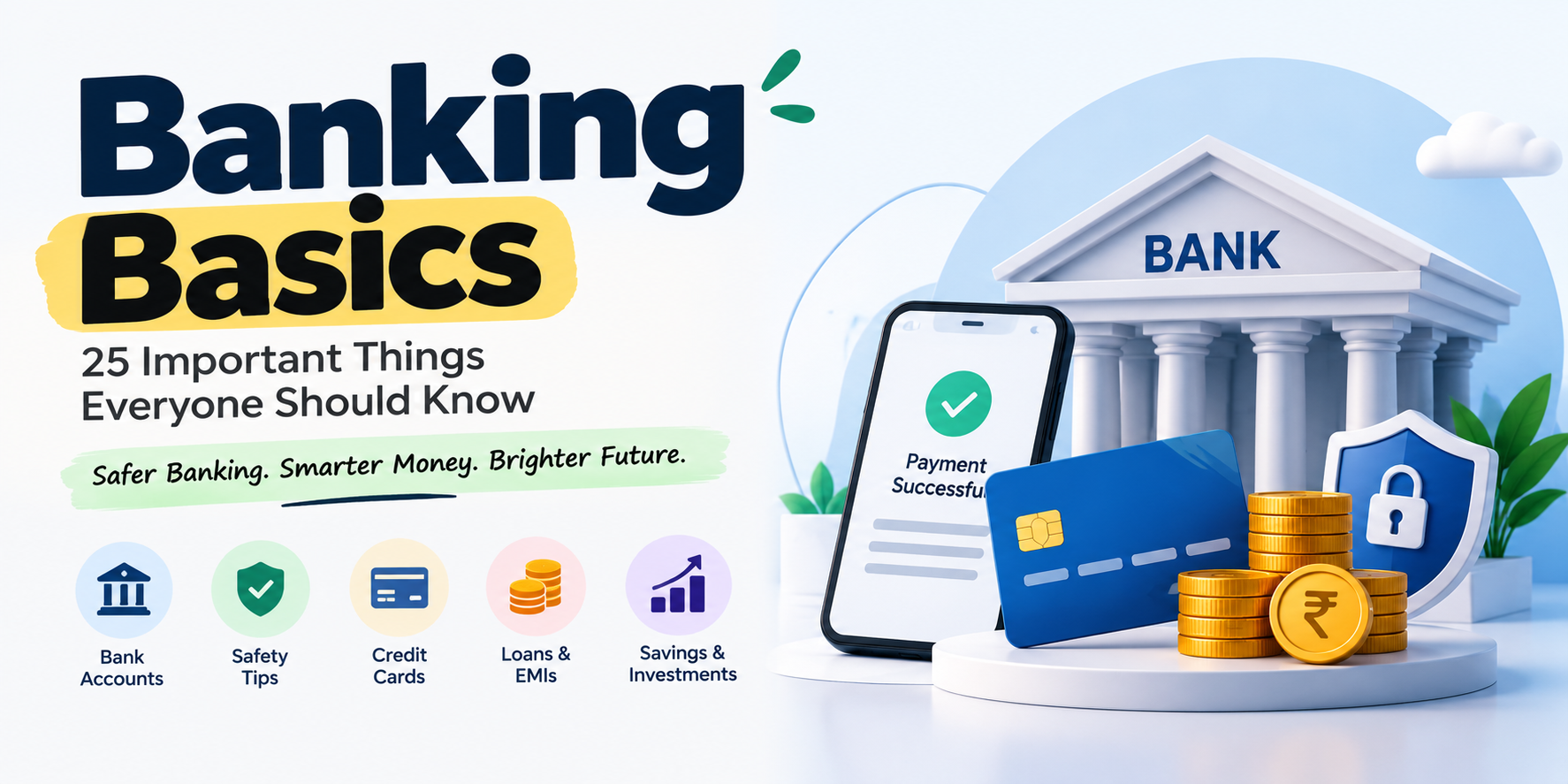
Banking has become so normal in everyday life that most of us hardly stop to think about it.
Your salary comes into your bank account. You pay electricity bills through UPI. You transfer money to family members. You use a debit card for shopping. Maybe you have an FD, a credit card, a home loan, or a small business account.
It all feels simple—until something goes wrong.
A payment fails. Your account gets frozen. A suspicious transaction appears. You see a bank charge you did not expect. Your loan interest changes. Or you suddenly realise that you have been using a bank account for years without really knowing how some of its important features work.
That is why basic banking knowledge matters.
You do not need to become a banker or financial expert. But knowing how your bank account works can help you protect your money, understand charges, use credit responsibly and make better financial decisions.
This guide covers some of the most important banking concepts that every ordinary customer should understand.
Note: Banking rules, charges, interest rates, limits and regulatory requirements can change. Always check your bank's latest terms and the current guidance of the Reserve Bank of India (RBI) before making an important financial decision.
1. Know What Type of Bank Account You Have
Not every bank account is designed for the same purpose.
The most common account for an individual is a savings account. It is generally used for everyday banking, receiving salary, making payments and keeping personal savings.
A current account is generally designed for businesses and customers who need frequent transactions.
Then there are deposit products such as:
- Fixed Deposits (FDs)
- Recurring Deposits (RDs)
- Other term-deposit products
The first step in understanding your banking is knowing exactly what account or product you have.
It sounds obvious, but many people never look beyond the account number and bank name.
Read your account type, applicable interest rate, minimum balance requirements, charges and service conditions at least once.
2. Your Bank Account Is Not Just a Place to Keep Money
A bank account does much more than store your money.
It creates a financial record.
Your account statement shows money coming in and going out. That record can become useful when you need to:
- Track spending
- Check salary credits
- Verify payments
- Identify suspicious transactions
- Demonstrate income
- Prepare financial records
- Reconcile business transactions
This is one reason you should review your bank statement regularly.
You do not need to inspect every transaction every morning. But ignoring your account completely is a bad habit.
3. Understand KYC
You have probably heard the term KYC, which means Know Your Customer.
KYC is part of the customer-identification framework used by regulated financial institutions.
Banks may ask for identity and address information when opening accounts and may require periodic updating of customer information under applicable rules. RBI guidance covers customer identification and due-diligence requirements.
KYC is not merely paperwork.
It helps banks identify customers and is part of efforts to prevent misuse of the financial system, fraud and money laundering.
If your bank asks you to update KYC, do not ignore the message simply because the account has been working normally.
At the same time, never give sensitive documents to an unknown person claiming to be from the bank. Use official banking channels.
4. Do Not Share Your OTP
This sounds like the most basic banking rule in the world.
Yet people still lose money because they share OTPs.
An OTP, or One-Time Password, is commonly used as part of transaction or authentication processes.
A genuine bank employee should not need you to casually disclose your OTP over a phone call just because they say they are “verifying your account.”
The same caution applies to:
- UPI PIN
- ATM PIN
- Internet banking password
- Card CVV
- Mobile banking credentials
Treat these details as confidential.
A convincing phone call is still just a phone call.
5. Your UPI PIN Is Not a Password for Receiving Money
This is a particularly important point for new digital-payment users.
When you make a UPI payment, the UPI PIN may be required to authorise the transaction.
You generally do not need to enter your UPI PIN just to receive money.
So when somebody says:
“I am sending you money. Enter your UPI PIN to receive it.”
Stop and check.
Entering a UPI PIN is commonly associated with authorising a debit/payment transaction, not simply accepting money.
Scammers often rely on confusion between “collecting money” and “sending money.”
6. Check Your Bank Statements
Make it a habit.
A quick review of your statement can reveal:
- Unknown transactions
- Unwanted subscriptions
- Bank charges
- Duplicate payments
- Failed transactions
- Unexpected credits
- EMI deductions
- Standing instructions
The sooner you notice something unusual, the sooner you can contact the bank through its official channels.
Do not wait until the end of the year to discover that an unknown amount has been leaving your account every month.
7. Know Your Bank Charges
Banking is not always free.
Depending on the account and service, charges can arise from various activities.
For example, there may be charges related to:
- Certain cash transactions
- Specific card services
- Account maintenance
- Demand drafts
- Remittances
- Cheque-related services
- Some ATM usage beyond applicable limits
- Additional banking services
The exact structure differs across banks and products.
Do not rely on what someone told you five years ago.
Look at your bank's current schedule of charges.
This is especially important if you operate a business account or make frequent cash transactions.
8. Learn the Difference Between Debit and Credit
The words sound similar, which is why beginners often mix them up.
When money is debited from your account, money leaves your account.
When money is credited, money comes into your account.
For example:
Salary received → credit.
Electricity bill paid → debit.
ATM cash withdrawal → debit.
Refund received → credit.
Once you start thinking in these terms, bank statements become much easier to understand.
9. Understand IFSC
IFSC stands for Indian Financial System Code.
It is used to identify a particular bank branch for electronic fund transfers.
You may come across the IFSC when making certain bank transfers or adding a beneficiary.
Always check the bank-provided details carefully before initiating a transaction.
One incorrect digit can turn a five-minute transfer into a long customer-support conversation.
10. Keep Your Registered Mobile Number Updated
Your registered mobile number is extremely important.
It may be used for:
- Transaction alerts
- OTPs
- Security notifications
- Service communication
- Account-related updates
If your phone number changes, update it through the bank's official process.
The same applies to your email address.
Ignoring old contact details can make account management unnecessarily difficult.
11. Understand the Difference Between an FD and a Savings Account
Money sitting in a regular savings account and money placed in a fixed deposit serve different purposes.
A savings account focuses on accessibility and routine transactions.
A fixed deposit generally involves committing money for a specified tenure at an applicable interest rate.
People often use FDs for money they may not need immediately.
But do not select an FD simply because someone says, “FD gives guaranteed high returns.”
Look at:
- Tenure
- Interest rate
- Premature withdrawal conditions
- Tax implications
- Renewal instructions
- Payout options
The right banking product depends on why you are keeping the money there.
12. Deposit Insurance Is Something Every Depositor Should Know
One of the most useful banking facts that many people do not know concerns deposit insurance.
The Deposit Insurance and Credit Guarantee Corporation (DICGC) states that eligible deposits in an insured bank are covered up to a maximum of ₹5 lakh per depositor, including principal and interest, subject to the applicable rules. Deposits held in different branches of the same bank are generally aggregated for this purpose.
This is an important distinction:
Putting ₹2 lakh into four different savings accounts at the same bank does not automatically create four separate ₹5 lakh insurance covers.
DICGC explains that deposits held in the same right and same capacity at the same bank are aggregated for insurance purposes. Deposits at different banks are insured separately.
That is a detail worth remembering when managing large cash reserves.
13. A Bank Deposit Is Not the Same as an Investment
A bank savings deposit, an FD, a mutual fund and a stock are very different financial products.
You may use a bank to hold money and also use a bank or financial platform to access investment products, but that does not make them the same thing.
DICGC specifically notes that mutual funds, stocks, bonds, ETFs and cryptocurrencies are not covered by its bank-deposit insurance scheme.
This is why you should understand the product before assuming your money receives the same protection or treatment.
14. Credit Cards Are Not Free Money
A credit card can be extremely convenient.
But it is still borrowed money.
You buy something today and the issuer allows you to pay later according to the card terms.
The danger begins when people start thinking:
“I still have ₹1 lakh of credit limit, so I can spend ₹1 lakh.”
A credit limit is not income.
It is the maximum amount you may be able to borrow under the card's conditions.
Use a credit card responsibly, pay attention to the statement, and understand interest and other applicable charges.
15. Always Know Your Credit Card Due Date
Credit-card statements often show several numbers, which can be confusing.
You may see:
- Total amount due
- Minimum amount due
- Payment due date
Do not automatically assume that paying the minimum amount is the same as clearing the bill.
The minimum payment may prevent certain immediate consequences under the issuer's terms, but unpaid balances can continue to attract applicable interest and charges.
Read your card statement.
It is much cheaper than learning through a late-payment experience.
16. Your Credit Score Matters
A credit score reflects information from your credit history, subject to the scoring methodology used by the relevant credit bureau.
It can be relevant when you apply for credit products such as loans or credit cards.
Factors can include your repayment behaviour, credit utilisation and other information contained in your credit report.
The simple lesson is:
Borrow carefully and repay on time.
A good borrowing history is built slowly.
One missed payment can create unnecessary trouble.
17. EMI Does Not Mean the Loan Is Cheap
“Only ₹9,999 per month!”
Sounds attractive.
But the EMI alone does not tell you the true cost of a loan.
Before taking a loan, consider:
- Principal amount
- Interest rate
- Tenure
- Processing fees
- Insurance or additional costs where applicable
- Prepayment conditions
- Total repayment amount
A smaller EMI can sometimes simply mean a longer loan period.
Always ask:
How much will I pay in total?
That is a much more useful question than:
What is the monthly EMI?
18. Understand Fixed and Floating Interest Rates
When dealing with loans, you may come across fixed and floating interest rates.
A fixed-rate arrangement may keep the applicable rate unchanged according to the product's terms for the relevant period.
A floating-rate loan can move when the underlying benchmark or rate structure changes.
The practical effect is important.
If your loan has a floating rate, changes in rates can affect your interest burden or repayment schedule depending on the loan terms.
Never sign a loan agreement without understanding how the rate can change.
19. Never Ignore a Failed or Reversed Transaction
Digital payments sometimes fail.
You might see:
- Payment failed
- Payment pending
- Amount debited but transaction failed
- Amount reversed
Do not panic.
First, check the transaction status in the relevant banking or payment application.
Then check whether the amount has been refunded or reversed.
Keep the transaction reference number.
If money remains stuck, contact the bank or payment provider through the official support process.
That reference number can make customer support much more effective.
20. Save Transaction Reference Numbers
This small habit can save a surprising amount of time.
Whenever you make an important transfer or payment, keep the transaction reference number until the payment is successfully completed.
This becomes especially useful for:
- Rent
- Business payments
- Fees
- Government payments
- Large transfers
- Vendor settlements
- Refund disputes
Screenshots are useful for quick reference, but do not rely only on screenshots. Your actual bank statement is the more important record.
21. Be Careful With “Urgent” Bank Calls
Scammers love urgency.
They may tell you:
“Your account will be blocked in 10 minutes.”
“Your KYC will expire today.”
“Your card will be cancelled.”
“Your refund is waiting.”
“Your account is under investigation.”
The goal is to make you react before you think.
Instead of continuing the call, independently contact the bank using the official number from its website, mobile app, card or branch.
Never trust the phone number supplied by the caller.
22. Never Install Unknown Apps for Banking Help
Another increasingly common scam involves convincing people to install an application for “KYC verification,” “refund processing,” “bank support” or “technical assistance.”
Once installed, such software may allow criminals to attempt to access sensitive information or manipulate the victim.
The safest approach is simple:
Download banking apps only from official app stores and verify that you are using the bank's genuine application.
When in doubt, visit the bank's official website manually instead of clicking random links.
23. Keep Your ATM and Debit Card Safe
Your physical card still matters.
Do not share:
- Card number unnecessarily
- CVV
- PIN
- OTP
When using an ATM, protect your PIN from people standing nearby.
Check the ATM surroundings.
And if your card is lost or stolen, report it promptly through official banking channels.
Do not assume that because there is no cash in the account right now, the card does not matter.
Your financial situation can change tomorrow.
24. Understand Nomination
A bank account can have a nominee according to applicable banking rules and documentation.
Nomination is a simple but often neglected feature.
Many people spend years managing savings, investments and deposits but never update their nominee information.
Life is unpredictable.
Keeping nomination information current can make the process easier for the people handling your financial affairs when necessary.
Do not think of nomination as something only older people need to worry about.
Anyone with savings should think about it.
25. Keep Personal and Business Banking Separate
This one is especially important for freelancers, entrepreneurs and small-business owners.
Imagine receiving client payments, salary-like personal income, family transfers and shopping refunds into the same account.
After a while, your statement becomes difficult to understand.
A separate business account or properly organised business banking structure can make it easier to track:
- Revenue
- Expenses
- Vendor payments
- Taxes
- Salaries
- Profit
- Cash flow
It also makes accounting and financial reporting much more organised.
Your bank statement should tell a story.
For a business, that story should be easy to read.
Banking and Digital Payments: Convenience Needs Responsibility
India's digital-payment ecosystem has made everyday money movement incredibly convenient.
You can transfer money in seconds.
You can pay a restaurant bill without carrying cash.
You can buy products online, recharge your phone, pay bills and send money to family from your phone.
But convenience can create overconfidence.
When transactions become effortless, people sometimes stop checking them.
That is why digital banking requires two things at the same time:
Speed and attention.
Before sending money, verify the recipient.
Before approving a payment, check the amount.
Before clicking a banking link, verify the website.
Before sharing information, ask yourself:
Does this person really need this information?
Usually, the answer is no.
Build a Simple Banking Routine
You do not need to spend hours managing your bank accounts.
A simple routine can be enough.
Once a week, check recent transactions.
Once a month, review subscriptions, EMIs and recurring payments.
Every few months, review your account charges and contact details.
Once a year, review your deposits, loans, nominees and overall banking arrangement.
These little checks can prevent bigger problems later.
What Every Young Person Should Learn About Banking
Young adults often enter the financial world through a salary account or UPI.
That is only the beginning.
Before taking a loan or credit card, learn about interest.
Before investing, understand the difference between deposits and investments.
Before opening an account, understand the charges.
Before using UPI, understand basic fraud protection.
Before signing a loan document, read the repayment terms.
Financial education is not only for wealthy people.
It is perhaps even more important for people who are building their finances from scratch.
What Business Owners Should Watch Closely
Business banking comes with another level of complexity.
A business owner should keep a close eye on:
Cash flow
Knowing money coming in versus money going out.
Receivables
Knowing which customers still owe money.
Payables
Knowing which vendors and suppliers need to be paid.
Bank charges
Checking whether transaction-related costs are eating into margins.
Loans and working capital
Knowing the actual cost of borrowing.
Tax-related payments
Keeping sufficient funds available for applicable obligations.
A profitable business can still face trouble if cash flow is poorly managed.
The bank balance today is not the same thing as profit.
The Biggest Banking Lesson: Read Before You Click or Sign
Many financial problems begin with one small moment.
A person clicks a link without checking.
Signs a loan agreement without reading it.
Takes a credit card without understanding the charges.
Ignores a statement.
Shares an OTP.
Approves a UPI request without checking the recipient.
Says yes because someone sounded confident.
Banking works best when you slow down for a few seconds before taking an important financial action.
Read.
Check.
Verify.
Then proceed.
Final Thoughts
Banking does not have to be complicated.
At its core, it is about three things:
Protect your money.
Understand your transactions.
Borrow responsibly.
Know the type of account you have.
Understand KYC requirements.
Keep your contact details updated.
Check your statements.
Know your bank's charges.
Protect your PINs, passwords and OTPs.
Understand how credit works.
Do not treat a credit limit as income.
Know that deposit insurance has a defined limit rather than assuming every rupee in every banking product receives the same protection. DICGC currently states that eligible deposits are insured up to ₹5 lakh per depositor per insured bank, subject to applicable conditions.
Most importantly, do not let convenience replace awareness.
Your bank account is more than an app on your phone.
It is connected to your salary, savings, investments, loans, bills, business and financial history.
The more you understand it, the more confidently you can manage your money.
And you do not need to know everything.
Start with the basics.
Know where your money is going.
Know what you are paying.
Know what you are signing.
And always verify before trusting an unexpected banking message.
That alone can make a surprisingly big difference.
Disclaimer: This article is for general educational purposes and is not financial, legal or tax advice. Banking products, interest rates, charges, customer-protection procedures and regulatory requirements may vary and may change over time. Refer to your bank, RBI and other relevant official sources for current requirements applicable to your situation.


No comments yet
Have a question or insight regarding this guide? Share your thoughts below!
Leave Your Comment & Question
Your email address will not be published. Required fields are marked *