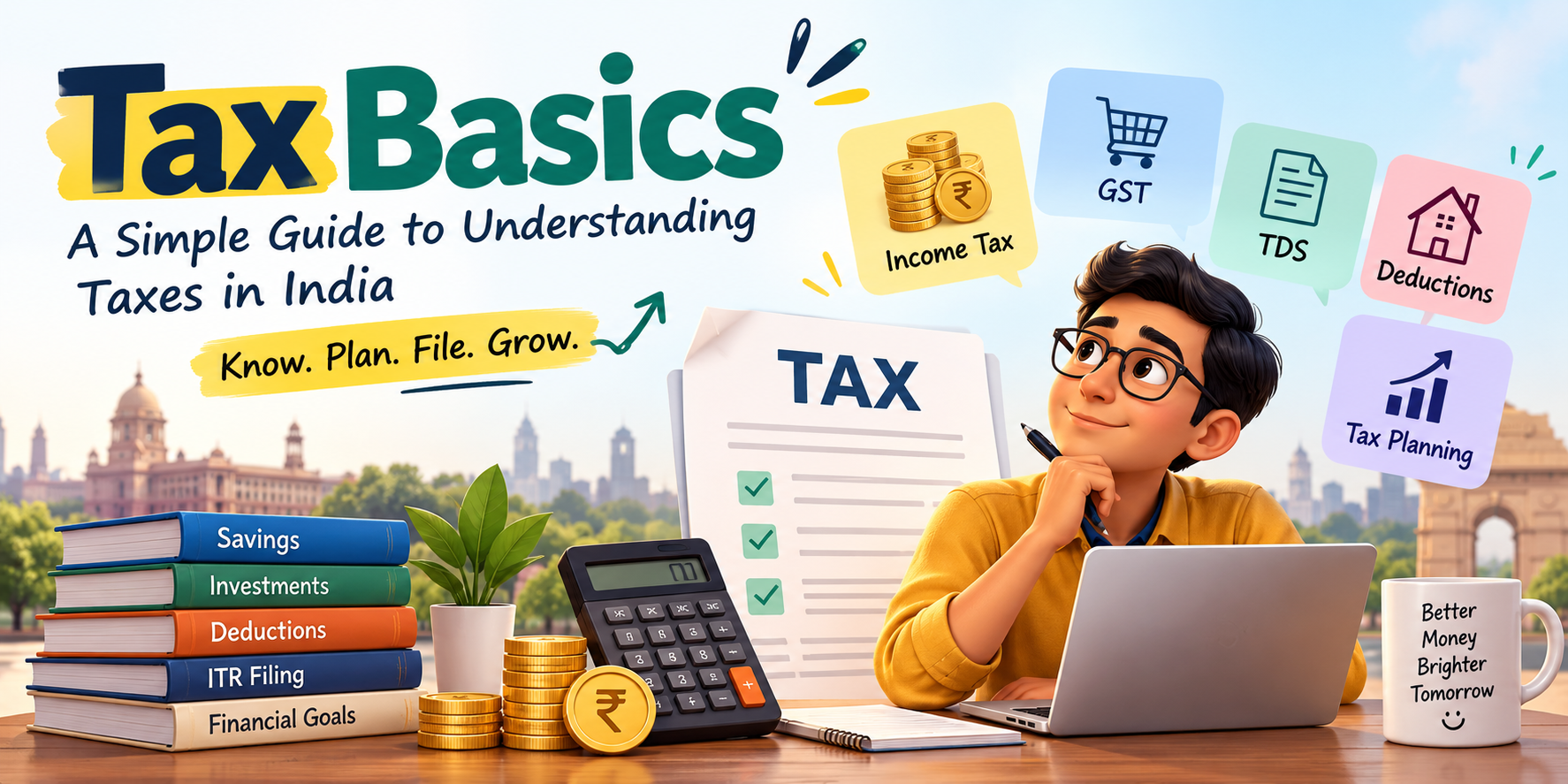
Tax Basics: A Simple Guide to Understanding Taxes in India
The word tax can make even financially confident people pause for a moment.
You may have seen tax deducted from your salary, noticed GST on a restaurant bill, received a TDS certificate, or heard someone talking about filing an ITR. But when all these terms start appearing together, taxation can feel much more complicated than it really is.
The good news is that you do not need to be a tax expert to understand the basics.
You simply need to know what type of tax applies to you, why you are paying it, how it is calculated, and what responsibilities you have as a taxpayer.
Taxes are essentially one of the ways governments collect money to fund public services and infrastructure. Roads, public transport, schools, hospitals, administration, defence and many other public functions require funding. At the individual level, understanding taxes also matters because proper tax planning can help you manage your money more efficiently and avoid unnecessary compliance problems.
This guide explains tax basics in India in straightforward language. It covers income tax, GST, TDS, tax slabs, deductions, tax regimes, ITR filing, capital gains and some simple tax-planning habits.
The tax rules can change through budgets and amendments, so the figures and provisions discussed in this article should always be checked against the latest official guidance before filing a return or making a financial decision.
What Exactly Is Tax?
A tax is a mandatory payment made to the government by individuals, businesses and other eligible entities.
You normally do not receive a direct product or service in exchange for each rupee of tax you pay. Instead, tax revenue contributes to government spending and public systems.
There are two broad ways to think about taxes:
Direct taxes are generally paid directly by the person or entity responsible for the tax. Income tax is the most familiar example.
Indirect taxes are generally collected through transactions. GST, or Goods and Services Tax, is a major example. A business may collect GST from a customer and then deposit the applicable tax with the government.
This distinction is useful because the tax you see on your salary slip works very differently from the GST shown on a shopping bill.
Why Do We Pay Taxes?
Nobody likes seeing money leave their bank account, but taxation is a basic part of how modern governments operate.
Taxes help fund public expenditure such as:
-
Roads and infrastructure
-
Public healthcare
-
Education
-
Government administration
-
Defence and public safety
-
Transport systems
-
Social welfare programmes
-
Public development projects
Taxes also influence economic behaviour. Governments can use tax policies to encourage certain activities, support specific sectors or change consumer behaviour.
For an individual, however, the practical question is usually much simpler:
How much tax do I actually need to pay, and how do I calculate it correctly?
That brings us to income tax.
Understanding Income Tax
Income tax is a tax imposed on taxable income under the applicable income-tax laws.
If you earn money during a financial year, the tax department does not simply look at your bank balance and decide your tax.
Your income is considered under different categories, and applicable exemptions, deductions, rebates and other rules are taken into account before arriving at taxable income.
For individuals, income can broadly come from sources such as:
Salary Income
This includes your earnings from employment, such as basic salary, allowances, bonus and other taxable components.
Your employer may deduct TDS from your salary during the year.
Income From Business or Profession
This applies to business owners, freelancers, consultants, professionals and other self-employed individuals depending on their circumstances.
The tax calculation can differ significantly from that of a salaried employee because business expenses, presumptive taxation provisions and other rules may apply.
House Property Income
Income related to property can also have tax implications.
For example, rental income may be taxable subject to the relevant rules.
Capital Gains
When you sell certain investments or assets for a profit, the resulting gain may be taxable.
This can include gains from:
-
Shares
-
Mutual funds
-
Property
-
Securities
-
Other capital assets
The applicable treatment depends on the asset, holding period and current tax provisions.
Income From Other Sources
This can include certain forms of:
-
Interest income
-
Dividends
-
Certain gifts
-
Other taxable receipts
The important point is that your salary is not necessarily the only income the tax department considers.
Financial Year vs Assessment Year
This is one of the first confusing things people encounter when they start learning about income tax.
A Financial Year (FY) is the year in which you earn your income.
An Assessment Year (AY) is the year in which that income is assessed and the relevant tax return is filed.
For example, income earned during a financial year is generally reported in the following assessment year.
Many tax forms and government documents use both terms, so understanding the difference prevents a lot of confusion.
What Are Income Tax Slabs?
Income tax in India uses tax slabs for individuals under the applicable regime.
This means different portions of taxable income can be taxed at different rates.
For example, imagine a fictional tax system where:
-
First ₹4 lakh = 0%
-
Next ₹4 lakh = 5%
-
Next ₹4 lakh = 10%
If your taxable income is ₹10 lakh, it does not mean the entire ₹10 lakh is automatically taxed at 10%.
The slab mechanism applies different rates to different portions of income.
This is an important point because beginners often misunderstand marginal tax rates.
The official Income Tax Department currently lists the new tax regime as the default regime for eligible individual taxpayers, while eligible taxpayers can opt for the old regime subject to the applicable rules.
For AY 2026-27, the department lists the following new-regime slabs for individuals below 60 years:
| Taxable Income | New Regime Rate |
|---|---|
| Up to ₹4 lakh | Nil |
| ₹4 lakh–₹8 lakh | 5% |
| ₹8 lakh–₹12 lakh | 10% |
| ₹12 lakh–₹16 lakh | 15% |
| ₹16 lakh–₹20 lakh | 20% |
| ₹20 lakh–₹24 lakh | 25% |
| Above ₹24 lakh | 30% |
The tax department also states that the Section 87A rebate under the new regime was increased for AY 2026-27 and can apply to eligible taxpayers up to the specified income limit.
Because tax laws can change, always verify the slab rates and rebate rules applicable to your specific assessment year.
New Tax Regime vs Old Tax Regime
One of the most common tax questions in India is:
Which tax regime should I choose?
There is no universal answer because it depends on your income structure, deductions, exemptions and financial situation.
The new tax regime generally uses revised slab rates and has fewer deductions and exemptions available compared with the old regime.
The old tax regime retains more deductions and exemptions but uses the older slab structure.
The Income Tax Department describes the new regime as the default for eligible taxpayers and notes that eligible taxpayers may opt out under the applicable conditions.
Think of the two systems like two different routes to the same destination.
One may have a simpler road with fewer stops.
The other may take longer but offer more opportunities to reduce taxable income through eligible deductions and exemptions.
The right choice depends on the individual's circumstances.
What Is TDS?
TDS stands for Tax Deducted at Source.
It is a system where tax is deducted at the time certain payments are made rather than waiting until the end of the financial year.
For example, an employer may deduct tax from salary before paying the employee.
Similarly, TDS may apply to certain types of payments such as:
-
Interest
-
Rent
-
Professional fees
-
Commission
-
Contract payments
-
Certain other specified payments
The amount deducted is generally deposited with the government against the recipient's tax liability.
This is why your Form 16, Form 16A or other TDS-related documents can be important when preparing your tax return.
Is TDS the Same as Final Tax?
Not necessarily.
This is another common misunderstanding.
TDS is essentially a method of collecting tax during the year.
Your final tax liability is determined based on your actual taxable income and the applicable tax provisions.
Suppose ₹50,000 is deducted as TDS during the year, but after calculating your total tax liability, you discover that your tax liability is ₹40,000.
Depending on the circumstances, you may be eligible for a refund of the excess amount.
On the other hand, if your final liability is higher than the amount already deducted, you may have additional tax to pay.
So do not assume:
TDS deducted = final tax payable.
What Is GST?
GST stands for Goods and Services Tax.
Unlike income tax, GST is primarily connected with the supply of goods and services.
When you order a product online, eat at a restaurant, book certain services or purchase various taxable goods, GST may be included in the transaction.
For consumers, GST is often visible directly on invoices.
For businesses, GST can involve registration, invoicing, return filing, tax collection, input tax credit and compliance responsibilities depending on the nature and scale of operations.
That means GST is particularly important for:
-
Retailers
-
E-commerce sellers
-
Service providers
-
Manufacturers
-
Traders
-
Consultants
-
Restaurants
-
Online businesses
GST can become more complex when businesses deal with interstate supplies, input tax credit and multiple types of taxable transactions.
For that reason, business owners should maintain proper records rather than treating GST as simply “extra money added to the bill.”
Direct Tax vs Indirect Tax: A Simple Example
Imagine you work in an office and earn a salary.
The tax applicable to your taxable income is a direct tax because the liability is associated directly with your income.
Now suppose you use part of your salary to buy a television.
The invoice may include GST, which is an indirect tax collected through the transaction.
So, in everyday life, you may encounter both types without even thinking about them.
What Are Tax Deductions?
A tax deduction can reduce the income on which tax is calculated, subject to eligibility and applicable law.
This is different from a rebate.
A deduction generally reduces taxable income.
A rebate generally reduces the tax payable after the relevant tax calculation.
Under the old tax regime, taxpayers may have access to various deductions and exemptions depending on their circumstances.
Common areas people associate with deductions include:
-
Eligible investments
-
Certain insurance payments
-
Certain education-related expenses
-
Eligible housing-loan interest
-
Specified medical expenses
-
Certain donations
-
Other eligible expenses or investments
The exact availability and limits depend on the applicable provision and assessment year.
One important lesson is this:
Do not make an investment only because somebody says it will “save tax.”
A tax-saving product should still make financial sense for you.
Saving ₹10,000 in tax is not automatically a good decision if you spend ₹50,000 on something you did not need.
What Is a Tax Rebate?
A rebate is different from a deduction.
Suppose your tax calculation results in a tax amount of ₹20,000.
If you are eligible for a rebate of ₹20,000 under the applicable provisions, your final tax payable could become zero.
The rules regarding rebates, income limits and eligibility can change.
For example, the Income Tax Department has published updated Section 87A rebate information for AY 2026-27 under the new regime.
This is why copying an old tax calculation from a previous year can sometimes lead to mistakes.
What Is an ITR?
ITR stands for Income Tax Return.
It is the return you submit to the Income Tax Department reporting your income, deductions, tax paid and other relevant information.
Different ITR forms apply to different taxpayers and income situations.
For example, the applicable form can vary based on:
-
Salary income
-
Business or professional income
-
Capital gains
-
Foreign assets
-
Directorship
-
Unlisted shares
-
Other income sources
The Income Tax Department's guidance for AY 2026-27, for example, specifies situations in which certain individuals may need to use ITR-2 rather than simpler forms.
So selecting an ITR form should not be based simply on what your friend or colleague used.
Why Should You File Your ITR?
Many people think:
“My employer already deducted tax, so why should I file a return?”
Because TDS and ITR filing are not the same thing.
An ITR can:
-
Report your total income
-
Claim eligible refunds
-
Document your financial history
-
Report capital gains and other income
-
Help in certain loan applications
-
Help with some visa and financial documentation
-
Keep your tax records organised
-
Fulfil filing requirements where applicable
Even when a refund is expected, filing a return can be necessary to claim it.
Understanding Capital Gains Tax
Investing has become much more accessible. Millions of people now invest in stocks, mutual funds and other assets.
But investing also creates tax questions.
When you sell an investment for a profit, that profit may be treated as a capital gain, depending on the nature of the asset and transaction.
Capital gains are commonly divided into:
Short-term capital gains
and
Long-term capital gains
The exact definitions, rates and treatment depend on the asset and applicable law.
For example, the rules for listed shares can differ from the rules for property or other assets.
This is one area where simple internet formulas can be risky because the tax treatment can depend on details such as acquisition date, sale date, asset category and applicable amendments.
Tax on Rental Income
Owning a property can create another source of taxable income.
If you rent out a property, the rental receipts may have tax implications under the house-property provisions.
The calculation is not always simply:
Rent received = taxable income.
Applicable deductions and rules may affect the final taxable amount.
Property owners should therefore keep records of:
-
Rental agreements
-
Rent received
-
Property-related expenses
-
Housing loan information
-
Municipal taxes where relevant
-
Other supporting documents
Good records can make tax filing much easier.
Tax for Freelancers and Professionals
The growth of freelancing has changed the way people earn.
Today, someone can have:
-
A full-time job
-
Freelance clients
-
Online income
-
Consulting work
-
Affiliate income
-
Investment income
all at the same time.
That means tax planning for freelancers can be more complicated than for traditional salaried employees.
Freelancers and professionals should pay particular attention to:
-
Gross receipts
-
Business expenses
-
Invoices
-
TDS
-
Advance tax
-
GST applicability
-
Appropriate ITR form
-
Supporting financial records
The biggest mistake is usually waiting until the end of the financial year to understand where the money went.
Advance Tax: What Is It?
Income tax is not always meant to be paid only once a year.
In certain circumstances, taxpayers may need to pay advance tax during the financial year.
This is particularly relevant where significant tax is payable and TDS is not sufficient.
Freelancers, professionals, business owners, investors and people with multiple income streams may need to consider advance tax requirements.
The exact applicability and payment schedule depend on the taxpayer's situation and prevailing rules.
Ignoring advance tax requirements can potentially result in interest implications.
Why Keeping Financial Records Matters
Tax planning begins with organisation.
You do not need a giant accounting department to stay organised.
A simple system can work surprisingly well.
Keep records of:
Income
Salary, freelance payments, rent, interest, dividends and other receipts.
Investments
Stocks, mutual funds, deposits, property and other relevant assets.
Taxes already paid
TDS, advance tax and other applicable payments.
Eligible deductions
Insurance, investments, housing loan information and other supporting records.
Major transactions
Property purchases, property sales, large investments and similar transactions.
At the end of the year, these records can save hours of unnecessary stress.
Common Tax Mistakes People Make
Tax mistakes are often caused by confusion rather than bad intentions.
Here are some common examples.
Ignoring Small Sources of Income
People sometimes report salary but forget interest income, dividends, freelance earnings or other taxable income.
Small amounts can still matter.
Assuming TDS Means Everything Is Done
TDS is only one part of the tax process.
You still need to calculate your overall tax position.
Choosing a Tax Regime Without Comparing
Some taxpayers blindly select one regime every year without checking their deductions and income profile.
Forgetting Capital Gains
Selling investments can create tax consequences.
Do not assume that only salary matters.
Losing Documents
Missing Form 16, investment proofs, bank statements or transaction records can complicate tax filing.
Leaving Filing Until the Last Minute
Last-minute filing often leads to missing information, wrong forms and unnecessary pressure.
Simple Tax Planning Tips
Tax planning does not have to mean finding complicated loopholes.
Good tax planning usually means understanding your income early and using the provisions legally available to you.
Start by estimating your yearly income.
Then consider income from all sources, not just your main salary.
Next, identify the taxes already paid through TDS or advance tax.
Then check whether the old or new regime is applicable to you and compare the actual tax impact.
Finally, keep your records ready well before the filing deadline.
The best tax strategy is usually the one you can actually understand and maintain.
Tax Planning Is Not Tax Evasion
These two concepts should never be confused.
Tax planning means legally organising your financial affairs to use available provisions efficiently.
Tax evasion involves deliberately hiding income, creating false records or avoiding tax illegally.
One is lawful financial planning.
The other can create serious legal and financial consequences.
Always work within the law.
Do Investments Always Reduce Tax?
No.
This is a myth worth remembering.
Suppose somebody tells you:
“Invest ₹1 lakh and save tax.”
That statement might sound attractive, but it does not answer the important questions.
What is the investment?
What are the returns?
What are the risks?
How long is the money locked in?
What tax benefits actually apply?
Would you make the investment even without the tax benefit?
A tax-saving investment should fit your financial goals rather than the other way around.
What About Bank Interest?
Money sitting in a savings account, fixed deposit or other financial product can generate interest income.
Depending on the type of income and applicable rules, such income may have tax implications.
Banks may also deduct TDS in specified circumstances.
This is why people should not look only at salary slips when estimating their taxable income.
A complete tax picture may involve several sources.
Taxes for Business Owners
Business owners have another layer of responsibility.
Depending on the business structure and activities, they may need to think about:
-
Income tax
-
GST
-
TDS
-
Accounting records
-
Invoices
-
Business expenses
-
Payroll
-
Advance tax
-
Annual returns
-
Statutory compliance
A growing business should ideally separate personal and business transactions.
Using different bank accounts and maintaining proper books can make taxation significantly easier.
A Simple Example of Tax Thinking
Imagine Priya earns ₹12 lakh from her job.
She also earns ₹60,000 from bank interest and ₹40,000 from freelance work.
Her total income picture is therefore different from simply looking at her ₹12 lakh salary.
Now imagine she also sold investments during the year.
There may be capital gains.
Suddenly, her tax situation becomes more detailed.
This is why tax planning starts with one simple question:
What did I earn from every source during the year?
Once you know that, the rest becomes a calculation and compliance exercise.
Tax and Your Financial Life
Tax is not a separate financial topic.
It connects with almost everything else.
Your salary affects your tax.
Your investments affect your tax.
Your home loan can affect your tax.
Your property transactions can affect your tax.
Your business can affect your tax.
Your freelance income can affect your tax.
Even the way you structure your finances can influence your compliance responsibilities.
This is why basic tax knowledge is useful even if you have an accountant.
You do not need to replace a professional.
You simply need enough knowledge to understand what they are explaining.
When Should You Consult a Tax Professional?
Professional guidance can be particularly useful when your financial situation becomes complicated.
For example:
-
You operate multiple businesses
-
You have significant capital gains
-
You own rental properties
-
You have foreign income or assets
-
You are self-employed
-
You receive income from several countries
-
You have complicated investments
-
Your financial transactions are substantial
-
You receive a tax notice
A Chartered Accountant or qualified tax professional can help you interpret the rules that apply specifically to your circumstances.
Your Tax Checklist
A simple yearly tax checklist can make a major difference.
Start by collecting:
Income documents
Salary slips, Form 16, bank statements and business records.
Investment details
Mutual funds, shares, deposits and other investments.
Capital gain information
Purchase and sale records for relevant assets.
TDS information
Check your tax credit statements and certificates.
Deduction documents
Keep supporting documents for eligible deductions and exemptions.
Property documents
Rental income, purchase documents and housing-loan statements where relevant.
Once your records are ready, tax filing becomes far less intimidating.
Final Thoughts: Tax Does Not Have to Be Scary
Taxes are not the most exciting part of personal finance.
Nobody wakes up in the morning thinking, “Today I want to study tax deductions.”
But understanding taxes can save you from confusion, missed deadlines and poor financial decisions.
You do not need to memorise every section of the Income Tax Act.
You simply need a few strong habits:
Know your income.
Track your investments.
Understand TDS.
Keep your documents.
Check the applicable tax regime.
File the correct return.
And verify the latest rules before making important decisions.
Tax rules are updated from time to time, so old articles, social media posts and forwarded messages should never be treated as the final authority.
The Income Tax Department's official portal should be your first reference for current income-tax provisions, forms, filing guidance and applicable rates.
The bigger lesson is simple.
Tax knowledge is not about finding ways to avoid paying tax. It is about understanding what you are legally required to pay and managing your finances intelligently.
Once you stop seeing tax as a mysterious calculation and start seeing it as another part of personal finance, it becomes much easier to manage.
And honestly, that is the goal.
Not becoming a tax expert.
Just becoming a little more financially aware.
Note: This article is intended for general educational purposes. Tax treatment depends on individual facts and the law applicable to the relevant financial year/assessment year. Check the latest official guidance or consult a qualified tax professional before taking a tax position.

No comments yet
Have a question or insight regarding this guide? Share your thoughts below!
Leave Your Comment & Question
Your email address will not be published. Required fields are marked *