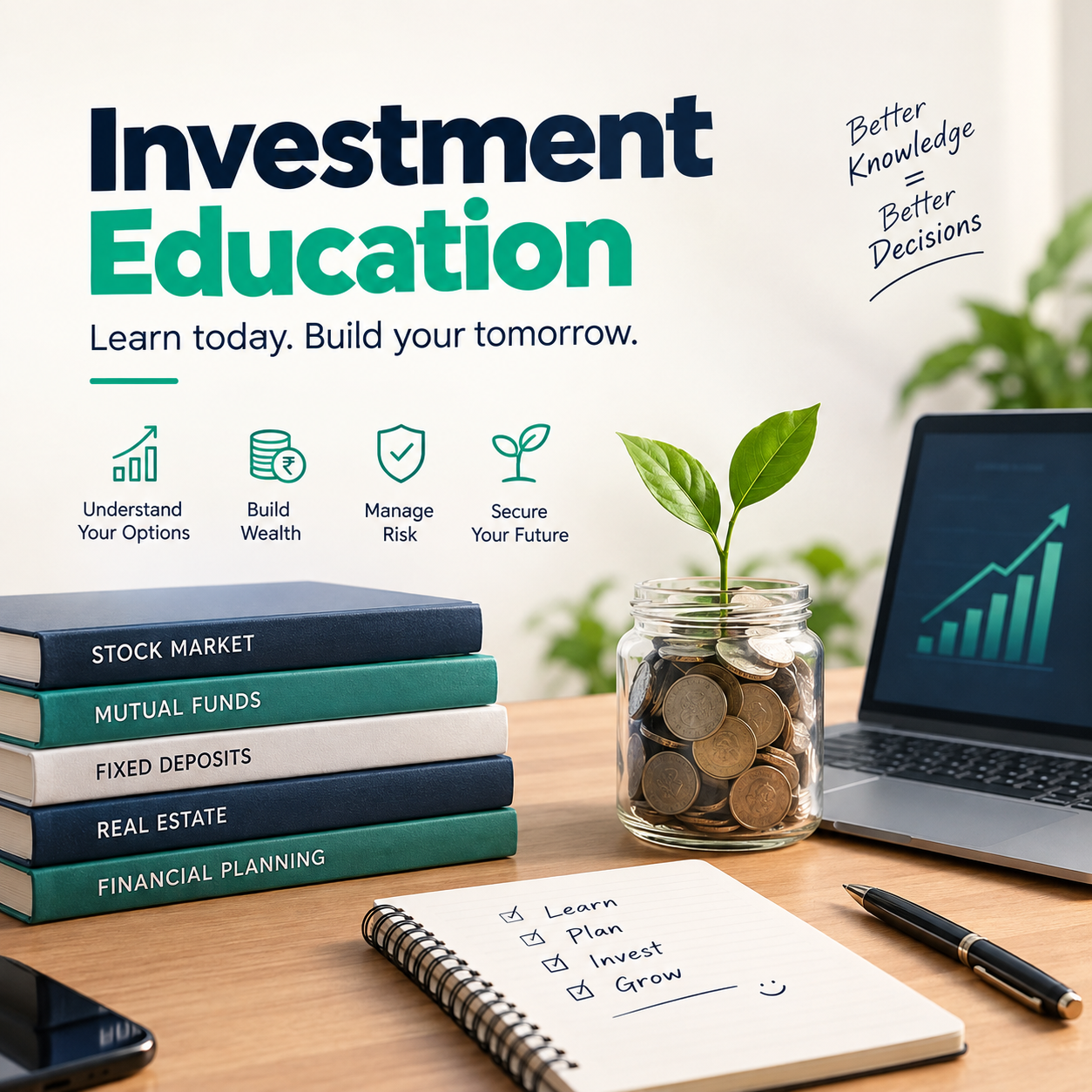
Students are conditioned to spend twelve or more years studying algebra, chemistry, and world history. However, the majority of them will never receive an education on personal finance or investing. This lack of economic literacy is one of the reasons why investment education has become one of the most important areas in recent decades.
This article aims to discuss investment education, analyze its importance, cover the basics everyone should understand, common mistakes, and provide guidance on learning how to invest and build wealth — whether you have little experience or a decent income.
Investment Education: What Does It Consist Of?
Investment education can be defined as the process of learning about financial markets and studying different assets' behavior in order to gain the knowledge needed to grow wealth through investing. Simply put, an individual who has completed investment education has a comprehensive grasp of financial markets and can learn how to invest their money to let it grow, rather than letting it sit in the bank.
The main characteristics of investment education include:
- Analyzing stock exchange trends
- Understanding how markets tend to behave
- Being aware of various types of financial instruments
Moreover, investment education teaches you how much risk you have to withstand to achieve your financial objectives, and how to avoid common mistakes. Contrary to popular belief, investment education does not necessarily imply trading.
Importance of Investment Education
The importance of investment education is evident, bearing in mind that personal finance management is one of the most crucial aspects of human life. Financial literacy is paramount to reaching retirement savings goals, buying a home, paying children's educational fees, or simply maintaining a stable income. Below are a few vital ideas everyone should consider before pursuing investment education.
1. Old-Style Retirement Savings Schemes Are Dying Out
Investment education has become vital for the growing number of people who cannot rely on pensions. Previously, it was common for people to retire and have a steady stream of income for the rest of their lives. Today, the traditional pension system is largely obsolete, and it is necessary to accumulate your own means to support yourself during retirement. Therefore, everyone should take it upon themselves to learn how to invest for retirement.
2. Fighting Inflation and Stagnant Salaries
Anyone who has had a bank savings account knows that keeping extra cash there is a losing proposition. It may seem harmless, but your purchasing power steadily drops as currency loses value due to inflation. Investment education is essential because it teaches you to hedge against inflation and preserve purchasing power by investing extra money into assets that appreciate faster than the rate of inflation.
3. Becoming Financially Independent and Free
Financial independence is not a must, but many people find it an excellent motivation to expand their knowledge of investing and the stock market in general. The primary reason is that financial independence gives you freedom of choice and an enhanced quality of life — the opportunity to make a big move, change careers, start a business, spend more time with family, and enjoy retirement.
4. Making Smarter Choices and Staying Calm
Financial education helps an individual remain composed and make smarter investment and financial decisions in general. The stock market is infamous for rampant price fluctuations and volatility across a wide range of assets. The key point here is to have a thorough understanding of financial markets in order to avoid making rash decisions during turbulent periods.
5. Avoiding Financial Fraud Schemes
Financial fraudsters are becoming more aggressive as more people become acquainted with financial literacy and invest more of their money in the stock market. Investment education provides you with the knowledge needed to avoid being a victim of a financial scam. In particular, it is essential to understand realistic yields on different financial products in order to avoid being deceived by banks and speculators offering absurd interest rates.
Basic Concepts Everyone Should Be Aware Of
It is essential for every aspiring investor to understand concepts that apply to virtually every strategy they will use in financial markets.
Compounding
It is often said that compound interest is the eighth wonder of the world. Compounding, in essence, is when an investment earns returns based on its principal plus any accumulated profits or interest from prior periods. For example, if someone invested $1,000 at an 8% annual return, they wouldn't just earn a flat amount each year — their gains would be reinvested, so future returns are calculated on a growing base. Even small, regular contributions can transform into substantial wealth over time.
Diversification
This means spreading investment money across different assets or markets rather than allocating a significant portion into one investment class. Diversification helps an individual hedge against the risk of losing everything if one allocated asset performs poorly.
Risk versus Reward
Generally, the higher the potential yield on an asset, the higher its risk. For example, stocks are often associated with higher risk compared to bonds. It is paramount to understand one's own risk tolerance before choosing a particular strategy and investment tools.
Time Horizon
This concept relates directly to the length of time one is willing and able to keep an investment before considering its sale. For example, a retirement plan set up for ten years from now requires a different allocation strategy than a fund set aside for an emergency.
Other Key Concepts:
- Stocks (shares of ownership in companies)
- Bonds (government or corporate notes that bear interest)
- Mutual funds and Exchange-Traded Funds (ETFs), which replicate indexes or a basket of different securities
- Real estate
- Cash and cash equivalents
Common Mistakes Everyone Should Avoid
Despite the fact that many investors strive to avoid mistakes, there are some common errors that unskilled and inexperienced investors tend to make.
Mistake #1: Market Timing
There is an old adage among investors: "timing the market is impossible." Many professional day-traders acknowledge this truth, and an average person with little experience is not likely to predict the stock market's short-term movements.
Mistake #2: Chasing Trends
This is a common mistake associated with buying assets that are only popular due to stock market hype. Trend-following has its benefits, but one must remember that popular assets have usually already rallied — so the timing of buying them is often wrong.
Mistake #3: Not Understanding Commissions and Fees
It often happens that an investor believes they've earned impressive returns until they realize that management fees, which seemed small, have significantly affected profitability.
Mistake #4: Being Impatient
New investors are frequently characterized by an extreme desire for rapid results, followed by enormous frustration when their expectations aren't met. They might abandon their strategy if it doesn't bring immediate benefits.
Mistake #5: Not Having Enough Emergency Savings and Prematurely Liquidating Securities
Many aspiring investors skip the vital step of building an emergency reserve before entering the stock market.
Building Wealth and Investment Knowledge
If you already have some basic literacy in economics, you might have an edge. However, everyone should start with simple, fundamental concepts — such as reading financial news and watching documentaries on financial markets.
Below are some guiding principles on the path to financial literacy:
- Education — Investment knowledge comes from education, experience, and research. Fortunately, there are plenty of articles, books, videos, and guides to help you along the way.
- Define your goals clearly — Keep your reasons for pursuing financial literacy in mind throughout the journey.
- Pick low-cost funds — Individual savings accounts are a great way to start investing and building wealth. Choose between mutual funds and index funds that track the performance of broad baskets of stocks, since diversification is essential for every investor.
- Take advantage of automation — Automating regular investments is highly recommended, as it removes guesswork and emotion from the process. In particular, dollar-cost averaging smooths out market volatility, so investors purchase more shares when prices are low and fewer when prices are high.
- Invest consistently and regularly — Once you've built a grasp of the fundamentals, you can begin investing. This is the stage where you'll likely make mistakes — and learn a great deal in the process.
- Never invest in anything you don't understand thoroughly — Beware of investment advisors or questionable platforms promising unrealistic yields.
Final Thoughts
Investment education is not a skill learned overnight, and there is no particular income threshold required to start the process. Everyone should understand that investing is a long-term commitment, and it is essential to avoid rash actions and stick to one's strategy.
The earlier one starts, the better. It is not necessary to have vast amounts of money to begin — what matters more is making wise investments that allow money to grow over time. Accumulated wealth stays with you, and it is essential to maintain it in order to keep building on it.
Ultimately, financial literacy will always pay off in the long run. This article has hopefully outlined why it is vital for each of us to obtain at least a fundamental understanding of finance concepts.
Disclaimer: This article is provided for informational purposes only. The author and/or publisher assume no responsibility for any use of this information and shall not be liable for any loss, damage, or expense incurred in connection with it.

No comments yet
Have a question or insight regarding this guide? Share your thoughts below!
Leave Your Comment & Question
Your email address will not be published. Required fields are marked *