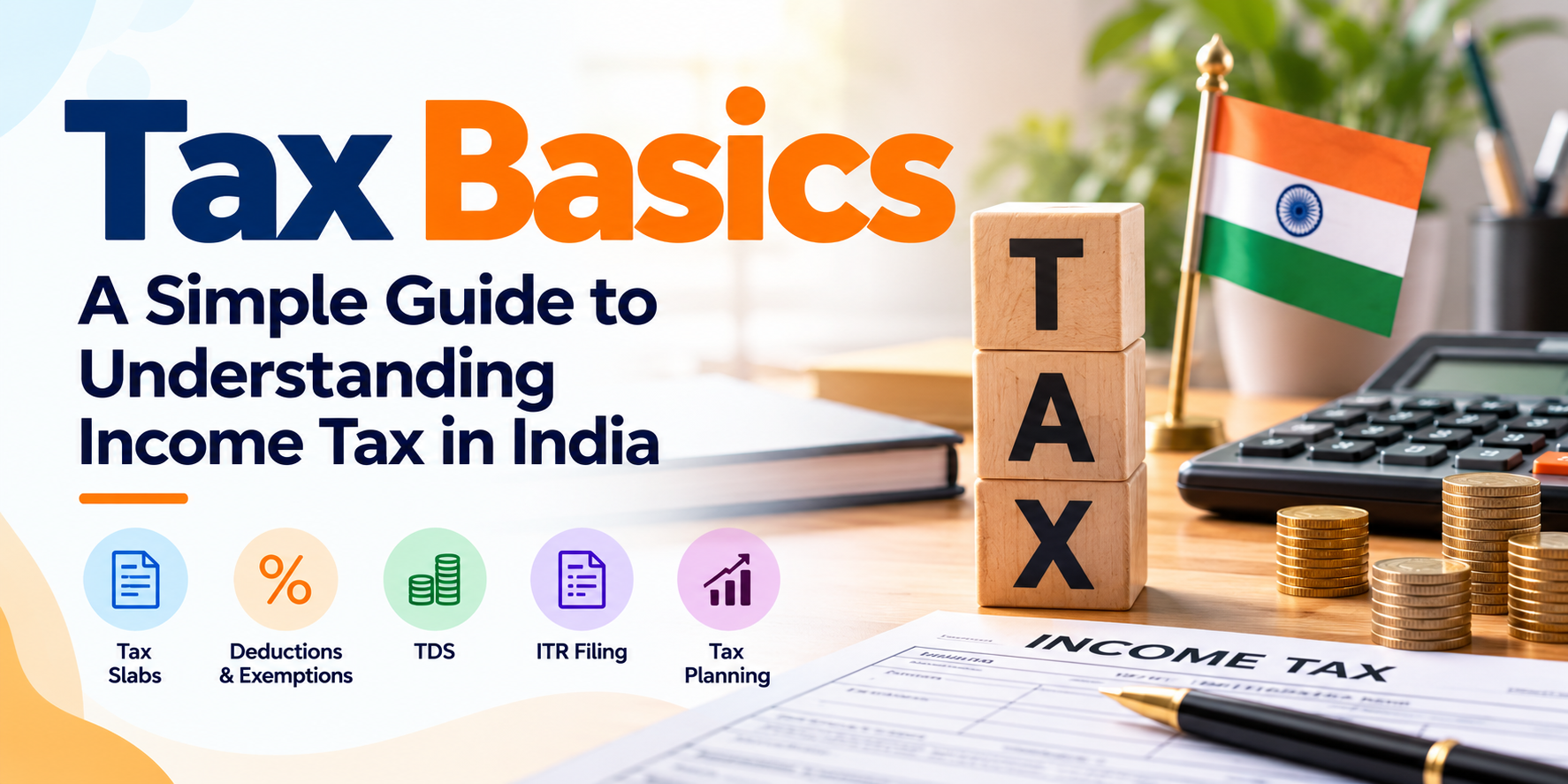
Tax is one of those words that can make people uncomfortable before they even know what it means. You hear terms such as taxable income, deductions, TDS, ITR, capital gains, tax slabs and exemptions, and suddenly a simple question like "Do I have to pay tax?" seems much harder than it should be.
The good news is that the basic idea of income tax is fairly simple.
You earn money. Some types of income are taxable. The government calculates tax according to the applicable rules, allows certain deductions or rebates where eligible, and expects you to report your income correctly.
The confusion usually starts because different kinds of income are treated differently, there are multiple tax regimes, and tax is sometimes deducted before you actually receive your money.
This guide explains the basics in plain language so that you can understand how income tax works, what an ITR is, why TDS appears on your salary or payment, and what you should keep track of throughout the year.
Important: Tax rules can change through Finance Acts and official notifications. The slab information mentioned below refers to the provisions shown by the Income Tax Department for Assessment Year 2026-27. For an actual tax filing or financial decision, check the latest government rules or consult a qualified tax professional.
What is income tax?
Income tax is a tax charged by the government on taxable income earned by individuals and certain other taxpayers.
Your income may come from several sources. A salaried employee may receive a monthly salary. A freelancer may earn from clients. A business owner may earn profits from a business. Someone may receive rent from a property, interest from investments or gains from selling an investment.
These different sources do not necessarily get treated in exactly the same way.
The first step in understanding tax is therefore to stop looking at your bank balance as your "taxable income."
Suppose ₹10 lakh enters your bank account during a financial year. That does not automatically mean your taxable income is ₹10 lakh. The amount may include salary, business receipts, reimbursements, transfers between your own accounts, loans or other amounts that have different tax treatment.
Tax calculation requires you to identify what the income actually represents.
Financial year and assessment year
Two terms confuse almost everyone when they first start dealing with income tax: Financial Year and Assessment Year.
The Financial Year (FY) is the period during which you earn your income. In India, it generally runs from April 1 to March 31.
The Assessment Year (AY) is the year in which that previous year's income is assessed and the income tax return is filed.
For example, income earned from April 1, 2025 to March 31, 2026 belongs to FY 2025-26. The corresponding assessment year is AY 2026-27.
Once this distinction becomes familiar, many tax documents become easier to understand.
The five broad heads of income
For income-tax purposes, income is generally classified under different heads. Understanding these categories helps you see why two people earning the same amount of money may not necessarily have the same tax calculation.
1. Income from salary
This covers income received from employment.
It can include basic salary, allowances, bonuses and other taxable components of employment income, subject to the applicable rules.
If you work for a company, your employer may deduct TDS from your salary and deposit it with the government on your behalf.
Your salary slip and Form 16 can therefore become important documents when you prepare your tax return.
2. Income from house property
If you own a property and earn rental income, that income may fall under the head "Income from House Property."
The calculation is not always as simple as taking the rent received and calling the entire amount taxable. The tax law provides specific rules for determining taxable income from property, including applicable deductions.
If you own multiple properties or have a home loan, the calculation can become more complicated.
3. Profits and gains from business or profession
Business owners, freelancers, consultants, doctors, designers, developers and other professionals may have income under this category.
For a business, revenue and profit are different things.
For example, imagine a small business receives ₹20 lakh from customers during a year. If the business spends ₹12 lakh on eligible business expenses, the taxable business income may be based on the applicable rules for determining profit rather than simply treating the entire ₹20 lakh as profit.
The actual calculation depends on the nature of the business, expenses, accounting method and applicable provisions.
4. Capital gains
When you sell certain capital assets, the resulting gain or loss may be considered under capital gains.
Examples can include certain shares, securities, mutual fund units, property and other assets.
Capital gains have their own rules, and the tax treatment can depend on the type of asset, acquisition details and holding period.
This is one area where casually calculating tax can lead to mistakes.
5. Income from other sources
Some income does not fit neatly into the previous categories.
Interest income is a common example. Certain dividend income and other specified receipts may also fall under this category depending on the circumstances.
If you have income from multiple sources, keeping records throughout the year is much easier than trying to reconstruct everything when the ITR deadline arrives.
What is taxable income?
A common mistake is to assume that your gross income and taxable income are always identical.
They are not.
Tax calculation can involve income classification, eligible deductions, exemptions where applicable, losses, rebates and other provisions.
Think of the process like preparing a financial map.
First, identify your income.
Then determine how each income source is treated.
After that, apply the deductions, exemptions or other adjustments available to you under the tax regime you are using.
The resulting amount is used to calculate tax according to the applicable rules.
This is why simply saying "I earn ₹15 lakh, so my tax is X" can be misleading without knowing what that ₹15 lakh consists of.
Old tax regime vs new tax regime
One of the biggest decisions many individual taxpayers face is choosing between the old and new tax regimes.
The new tax regime is the default regime for eligible taxpayers, although eligible taxpayers can opt for the old regime subject to the applicable rules.
The two regimes work differently.
The old regime has traditionally allowed taxpayers to claim a wider range of deductions and exemptions if they meet the relevant conditions.
The new regime uses revised slab rates and generally provides fewer deductions and exemptions.
Neither regime should automatically be considered "better" for everyone.
Consider two people with the same salary.
Person A has substantial eligible deductions and investments that qualify under the old regime.
Person B has relatively few deductions and prefers a simpler calculation.
Their better choice could be different.
The sensible approach is to compare the tax payable under both regimes based on your actual circumstances.
New tax regime slabs for AY 2026-27
For AY 2026-27, the Income Tax Department lists the following new-regime slab rates for individuals below 60 years of age:
| Taxable income | Rate |
|---|---|
| Up to ₹4 lakh | Nil |
| ₹4 lakh to ₹8 lakh | 5% |
| ₹8 lakh to ₹12 lakh | 10% |
| ₹12 lakh to ₹16 lakh | 15% |
| ₹16 lakh to ₹20 lakh | 20% |
| ₹20 lakh to ₹24 lakh | 25% |
| Above ₹24 lakh | 30% |
The Income Tax Department also states that the Section 87A rebate under the new regime was increased to ₹60,000 and applies to eligible taxpayers with total income up to ₹12 lakh from AY 2026-27.
Remember that a tax slab does not mean your entire income is taxed at the highest rate you reach.
For example, if part of your income falls into a 5% slab and another part falls into a 10% slab, each portion is considered according to the applicable slab structure.
That distinction is important because many people misunderstand marginal tax rates.
What is TDS?
TDS stands for Tax Deducted at Source.
The basic idea is straightforward. Instead of waiting until the end of the year to collect certain taxes, the government requires the payer to deduct tax at source in situations covered by the tax rules.
For example, an employer may deduct TDS from salary.
A client may also deduct TDS from certain professional or contractual payments when the relevant conditions are met.
You receive the remaining amount, while the deducted tax is deposited with the government.
TDS is therefore not necessarily an additional tax on top of your final income-tax liability.
It is generally a way of collecting tax in advance.
When you file your ITR, eligible TDS already deposited against your PAN is considered in your tax calculation.
If more tax was deducted than your final liability, you may become eligible for a refund, subject to the applicable rules.
Why should you check Form 26AS and AIS?
Taxpayers often assume that whatever appears in their bank account is enough information for filing an ITR.
It isn't.
Tax records can contain information reported by employers, banks, financial institutions and other reporting entities.
The Income Tax Department provides systems such as Form 26AS and the Annual Information Statement (AIS) to help taxpayers review information available against their tax profile.
Checking these records can help you identify discrepancies before filing your return.
For example, you might discover that:
-
TDS has been reported by an employer.
-
Bank interest has been reported.
-
Certain financial transactions appear in the statement.
-
A TDS amount is different from what you expected.
-
A transaction needs further clarification.
If something looks wrong, it is better to investigate it before submitting your return.
What is an ITR?
ITR stands for Income Tax Return.
An ITR is the return you submit to the Income Tax Department to report your income and relevant tax information for a particular financial year.
Different ITR forms apply to different situations.
For example, a person with only salary and certain other income may have a different filing requirement from someone running a business or profession.
This is why you should not select an ITR form simply because a friend, colleague or relative used it.
The correct form depends on your income sources and other circumstances.
Do people with no tax payable need to file an ITR?
This is one of the most common questions.
The answer depends on your circumstances and the applicable filing requirements.
Even where someone has little or no final tax liability, filing a return can still be useful or may be required in certain situations.
An ITR can provide an official record of income and tax compliance. It may also be useful when applying for a loan, visa, certain financial services or when documenting your financial history.
However, filing requirements should always be checked against the rules applicable to your particular situation.
Tax deductions: what do they actually mean?
A deduction reduces the amount considered for tax purposes when the relevant provision allows it.
Suppose a taxpayer has gross income of ₹10 lakh and qualifies for a ₹1 lakh deduction under a provision available to that taxpayer.
The calculation may then consider the applicable taxable amount after that deduction.
But deductions are not universal discounts.
Each deduction comes with conditions.
The old tax regime, for example, provides access to various deductions and exemptions that may not be available in the same way under the new regime.
This is why tax planning should begin with understanding your income and goals instead of blindly buying financial products just to "save tax."
Tax planning vs last-minute tax saving
Good tax planning starts early.
Bad tax planning often starts when someone suddenly realizes that the financial year is about to end.
This can lead to rushed decisions.
Someone may buy an unsuitable financial product because a salesperson says it will save tax. Another person may make an investment without understanding lock-in periods, charges or returns.
Tax saving should fit into your broader financial plan.
If an investment makes sense for your goals and also provides a tax benefit, that can be useful.
If you buy something only because it provides a deduction, you should first ask whether the investment itself makes sense.
Saving ₹20,000 in tax is not necessarily a good deal if you lock ₹2 lakh into a product you never wanted.
Tax basics for freelancers and small business owners
Freelancers often make one mistake that salaried employees rarely face: they confuse business receipts with personal income.
Imagine a freelance designer receives payments of ₹12 lakh during a year.
Those payments are business receipts. The actual taxable business income depends on the applicable rules, eligible expenses and the method available to that taxpayer.
The freelancer should therefore maintain records of:
-
Client invoices
-
Payments received
-
Business expenses
-
Bank statements
-
TDS certificates
-
GST records, where applicable
-
Contracts and agreements
-
Software and professional service expenses
-
Other relevant financial documents
Separate business and personal banking can also make record-keeping easier.
You do not want to spend an entire weekend trying to determine which of 400 bank transactions were client payments and which were personal transfers.
What about GST?
Income tax and GST are different taxes.
Income tax generally concerns income or profits under the applicable tax rules.
GST is an indirect tax system that applies to specified supplies of goods and services, subject to registration requirements, exemptions, thresholds and other rules.
A freelancer or business may therefore need to consider both income-tax and GST obligations, depending on the nature and scale of the activity.
Being registered for GST does not mean your GST turnover is automatically the same as your income-tax profit.
These are separate concepts and should be maintained separately in your records.
Common tax mistakes people make
Tax mistakes are often caused by poor record-keeping rather than complicated mathematics.
One common mistake is forgetting additional income.
Someone may report salary but forget bank interest, freelance income, rent or investment income.
Another mistake is assuming TDS means no ITR is required.
TDS is tax deducted at source. It does not automatically determine whether you have to file a return.
People also sometimes select the wrong ITR form or enter information without checking their tax statements.
Another frequent problem is keeping financial documents only in email or WhatsApp. If you need an old invoice several years later, finding it can become surprisingly difficult.
A simple folder structure can solve much of this.
Create folders for each financial year and keep salary documents, bank statements, investment records, invoices, TDS documents and tax returns together.
A simple yearly tax checklist
You do not need to become a tax expert to manage your basic tax responsibilities.
A simple routine can help.
At the beginning of the financial year, understand your expected income and whether you have salary, business, investment or rental income.
During the year, keep your documents updated.
Whenever you receive a salary statement, invoice, TDS certificate or investment document, save it.
Near the end of the financial year, review your income and eligible tax planning options.
After the financial year ends, compare your records with the information available through the Income Tax Department.
Then determine the appropriate ITR form and tax regime based on your circumstances.
Finally, file the return correctly and keep the acknowledgement and supporting records.
The entire process becomes much easier when you treat tax as a yearly financial routine rather than an annual emergency.
A simple example
Imagine Rahul works as a salaried employee and also earns some interest from bank deposits.
His salary is his main income. His employer deducts TDS during the year.
At the same time, his bank reports interest income.
When Rahul prepares his return, he should consider both sources rather than looking only at his salary.
He checks the relevant tax information, compares the available tax regimes, applies the provisions he is eligible for, calculates his final tax liability and adjusts the TDS already paid.
If the tax already paid is higher than the final liability, a refund may arise.
If it is lower, Rahul may have additional tax to pay.
The important lesson is simple: tax calculation looks at the overall tax position, not just the amount of TDS deducted from salary.
How to make tax less stressful
The easiest way to reduce tax-related stress is to stop treating it as a once-a-year activity.
Spend 15 to 20 minutes every month organizing your financial documents.
Keep a simple record of income received.
Download important tax statements.
Save investment proofs and invoices.
Review your bank interest.
Keep track of capital-market transactions if you invest.
If you run a business, maintain proper accounting records.
These small habits can save hours later.
Technology can help too. Spreadsheet templates, accounting software and document storage systems can make it easier to organize financial information. But software should support your understanding, not replace it.
If your finances include multiple businesses, properties, investments, international income or complicated transactions, professional tax advice can be worth the cost.
The biggest tax lesson
Tax is easier to understand when you break it into smaller questions.
Where did my income come from?
Which part of that income is taxable?
Which tax regime applies to me?
Which deductions or exemptions am I eligible for?
How much TDS has already been paid?
Which ITR form should I use?
Have I checked the information reported against my PAN?
Those questions are far more useful than simply asking, "How can I pay less tax?"
The goal should be accurate tax planning. Sometimes that results in lower tax. Sometimes it doesn't. Either way, understanding your numbers helps you make better financial decisions.
Final thoughts
You do not need to know every section of the Income Tax Act to manage your personal finances responsibly.
Start with the basics. Understand your income sources, learn how tax slabs work, know the difference between TDS and your final tax liability, keep your records organized and compare tax regimes based on your actual situation.
For AY 2026-27, the new tax regime has revised slabs and an increased Section 87A rebate for eligible taxpayers, making it particularly important to compare your options rather than relying on an old tax calculation.
Most importantly, don't wait until the filing deadline to discover what happened to your money during the year.
A little attention every month can turn tax from a confusing annual chore into an ordinary part of managing your finances.

No comments yet
Have a question or insight regarding this guide? Share your thoughts below!
Leave Your Comment & Question
Your email address will not be published. Required fields are marked *